What if farming didn't always need acres of land, endless waiting, or a farmer's alarm at 5 AM?
Agriculture is changing. Technology is making it possible to grow certain crops in controlled environments, use space more efficiently, and approach farming as a professionally managed business.
One crop gaining attention in this space is the humble mushroom.
Mushroom farming combines agriculture, technology and controlled cultivation and that is exactly what makes it interesting.
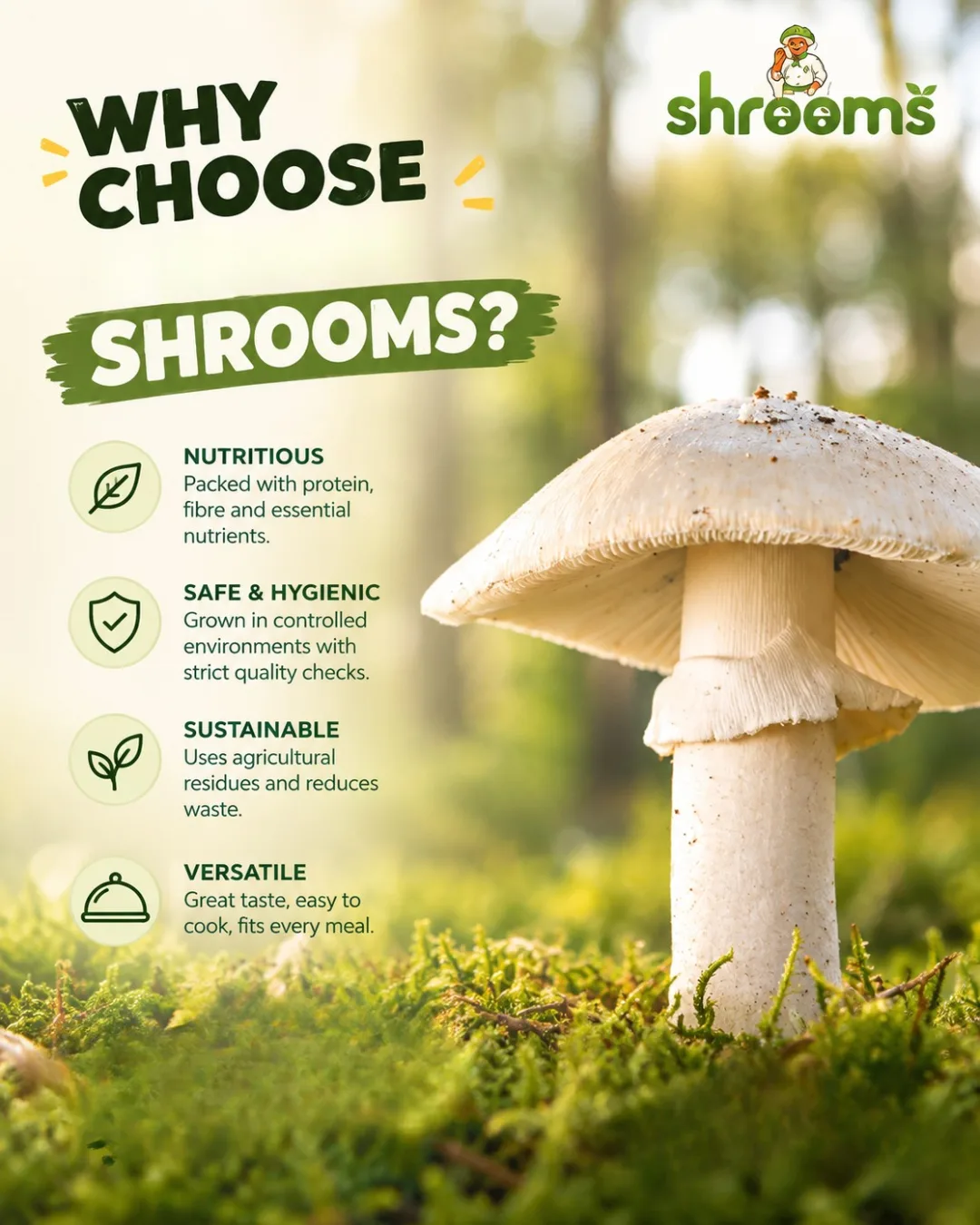
A) Why choose SHROOMS?
Because mushroom farming involves much more than putting mushroom bags inside a room.
It requires:
· Suitable growing infrastructure
· Crop selection
· Environmental management
· Hygiene and monitoring
· Labour and daily operations
· Harvest management
· Packaging
· Market planning
SHROOMS brings these elements together through a professionally managed mushroom cultivation model.
1) Farming with Less Dependence on Open Land
One of the biggest differences between mushroom farming and traditional agriculture is how production space is used. Mushrooms can be cultivated in controlled facilities instead of depending entirely on large open fields, making mushroom farming an interesting option for those exploring modern farming, compact agricultural models, and controlled-environment cultivation.
2) Technology Meets Agriculture
Mushroom cultivation may look simple from the outside, but successful production requires careful control of growing conditions such as temperature, humidity, ventilation, and sanitation, all of which can influence mushroom development. For example, ICAR has documented the successful cultivation of King Oyster mushrooms under controlled environmental conditions. This is where technology becomes valuable, and SHROOMS focuses on a technology-supported approach to mushroom cultivation.
3) From Agricultural Residue to Food
Here’s something many people don’t realize certain mushroom cultivation systems can use agricultural residues as growing substrates. Materials such as paddy straw can be used for oyster mushroom cultivation, creating another productive use for agricultural resources and turning what might otherwise be treated as waste into a useful growing medium. It creates an interesting cycle: Agricultural residue → growing medium → Mushroom → Food — that’s agriculture looking at waste a little differently.
B) How Does Mushroom Farming Work?
1. Growing medium A suitable substrate is prepared.
2. Spawning Mushroom spawn is introduced.
3. Incubation The growing units are maintained under appropriate conditions.
4. Fruiting Mushrooms begin developing when the required conditions are achieved.
5. Harvesting Mushrooms are harvested at the appropriate stage.
6. Market The harvested crop moves towards packaging and distribution.
C) Who Are SHROOMS For?
SHROOMS can be interesting for people who:
· Want to explore modern agriculture
· Are curious about mushroom farming
· Want to understand controlled-environment farming
· Are exploring alternative agricultural businesses
· Don't have the time or expertise to manage every farming activity themselves
· Want to learn more before entering the mushroom farming space
D) Frequently Asked Questions
1. Is mushroom farming profitable in India?
Mushroom farming can be commercially viable, but profitability depends on production, operating costs, market conditions and management. Returns should never be treated as guaranteed.
2. Which mushrooms are commonly cultivated?
Oyster, button, milky and specialty mushrooms such as King Oyster are among the varieties cultivated commercially.
3. Can mushrooms be grown without large farmland?
Yes. Many mushroom cultivation systems operate inside controlled growing facilities rather than requiring large open fields.
4. What is controlled-environment mushroom farming?
It is a cultivation approach where conditions such as temperature, humidity, ventilation and hygiene are managed to suit the crop.
SHROOMS is associated with a mushroom farming project in Turuvekere, Karnataka.
E) Conclusion
Mushroom farming is changing the way we think about modern agriculture. With controlled cultivation, efficient use of space, technology-supported growing conditions, and the potential to use agricultural residues as substrates, it offers an alternative model for producing food. For those exploring new-age farming opportunities, mushrooms show how technology and agriculture can work together to create smarter, more resource-conscious cultivation systems.
Curious about mushroom farming?
Explore how SHROOMS brings technology and modern cultivation together. Learn more about the opportunity and discover what’s growing next at www. cookshroom.com .