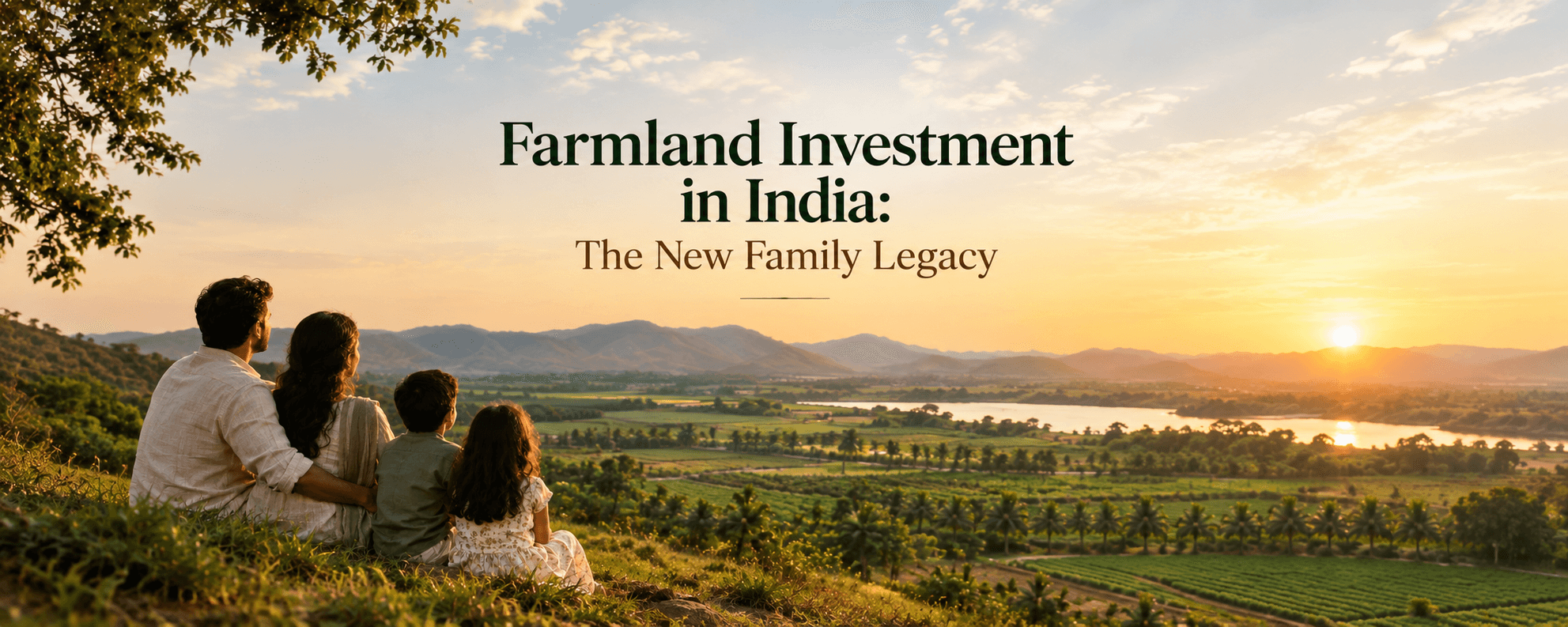
For generations, families have built wealth through homes, gold, businesses, and financial investments. Today, farmland investment is emerging as another option for families looking for tangible assets with a deeper connection to nature and agriculture.
What Is Farmland Investment?
Farmland investment is the ownership of agricultural land with the potential to generate long-term value through land ownership, farming activity, and agricultural development. Unlike assets that exist mainly on paper or digitally, farmland is a physical asset that families can visit, experience, and potentially pass down through generations.
Why Is Farmland Gaining Attention?
Farmland is increasingly being considered by people looking beyond traditional investments.
A Tangible, Living Asset
Land can become more than property. Trees grow, crops are cultivated, and the farm evolves over time. A family can visit the property during holidays, spend time in nature, and create experiences together.
This transforms ownership into something that can be experienced—not simply recorded as an asset.
Long-Term Family Value
Farmland can potentially serve different purposes across generations. For one generation, it may represent a land investment. For the next, it could become an agricultural property, weekend retreat, or a place to reconnect with nature.
However, farmland values and agricultural returns can vary depending on factors such as location, water availability, infrastructure, land quality, regulations, crop selection, and management. Like any investment, it requires careful evaluation.
How Can Managed Farmland Make Ownership Easier?
One of the biggest challenges of farmland ownership is management. Agriculture requires knowledge, labour, irrigation, crop planning, maintenance, and regular supervision.
Professional Management
Managed farmland can make ownership more accessible by allowing experienced professionals to handle farming and maintenance, depending on the project's structure.
This can allow landowners to enjoy the benefits and experience of farmland ownership without having to become full-time farmers.
Could Farmland Become a Family Legacy?
A family legacy isn't measured only by financial value. It can also be measured by the memories, experiences, and values passed to future generations.
A farm can become a place where families gather, children experience nature, trees are planted, produce is harvested, and traditions continue.
In that sense, farmland can bring together roots, memories, responsibility, and connection.
Mistakes / FAQs
Is farmland a guaranteed investment?
No. Farmland investment does not guarantee appreciation or agricultural returns. Location, land quality, water, management, regulations, and market conditions should all be evaluated carefully.
Is managed farmland suitable for everyone?
Managed farmland can simplify ownership, but every project has different structures, costs, management arrangements, and risks. Investors should understand the specific terms before making a decision.
Conclusion
- Farmland can be both a tangible asset and a meaningful family experience.
- Managed farmland can make agricultural ownership more accessible.
- Its long-term value should be evaluated based on location, management, agricultural potential, and project structure.
A family legacy doesn't always have to sit in a bank. Sometimes, it can grow beneath your feet.
CTA
GROW GREEN. OWN SMART.
Your piece of land. Our hands-on management. A future that grows with you.
Explore TwoFrogs Managed Farmland — thoughtfully developed agricultural projects designed to combine land ownership, professional farm management, nature, and long-term value.