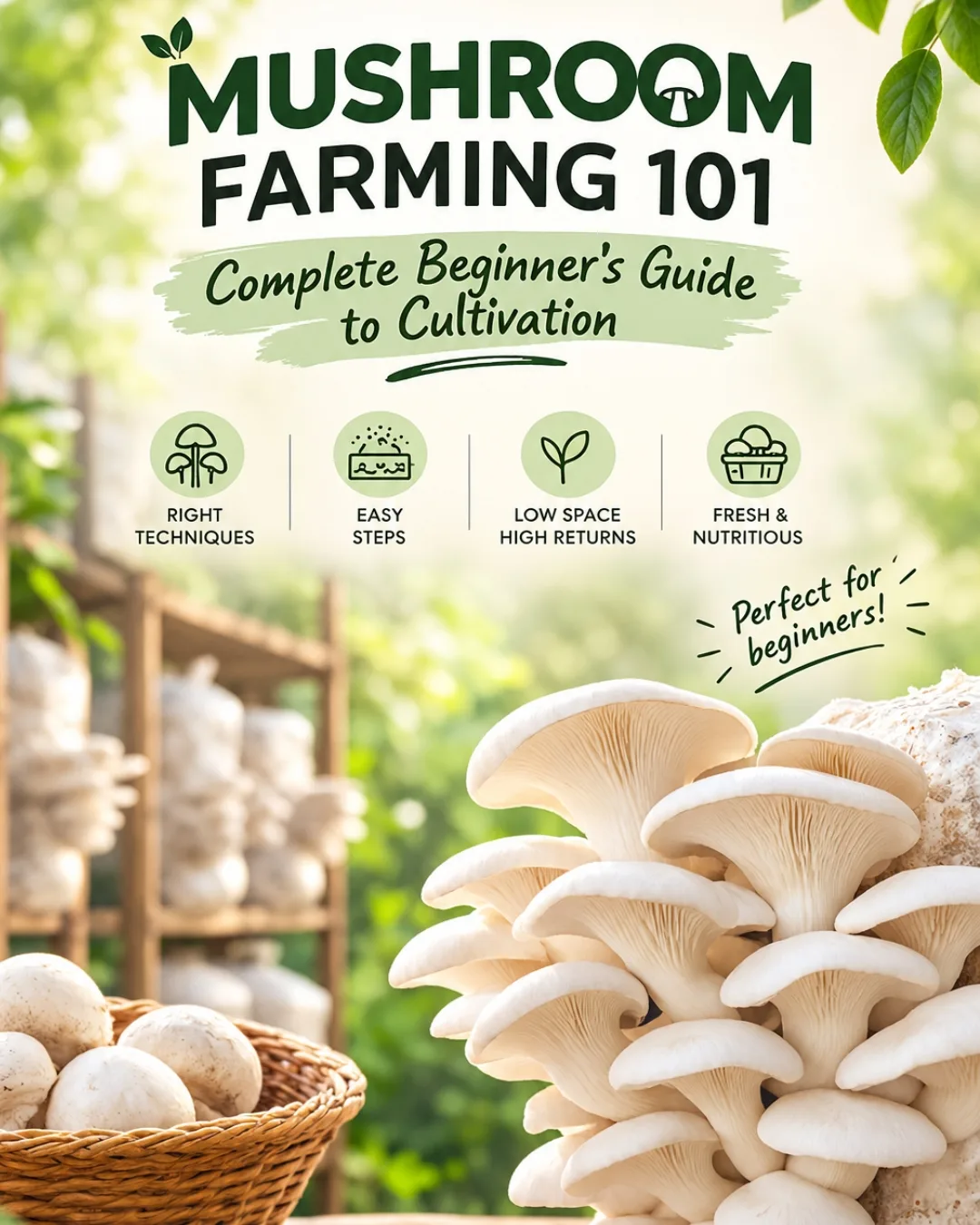
As agriculture faces rising land costs, unpredictable weather and resource constraints, mushroom farming offers a smart way to produce more with less. Unlike traditional crops, mushrooms can be grown in controlled environments using agricultural by-products, making them an attractive opportunity for small farmers, rural entrepreneurs and modern agri-businesses.
A) Why Mushroom Farming Is Becoming a Smart Choice for Modern Agriculture
Modern farming faces a growing challenge: producing more value with fewer resources. With rising land costs, water constraints, changing weather and labour needs, mushroom cultivation offers an efficient alternative. Grown in controlled environments, mushrooms allow farmers to manage temperature, moisture, ventilation and cleanliness, making them a promising complement to traditional agriculture.
B) Mushrooms Can Produce Value Without Requiring Large Fields
Unlike traditional crops that need open farmland, mushrooms can be grown vertically using racks, shelves, bags or growing beds. This allows multiple growing levels within a compact space and supports repeated production cycles. Rather than replacing conventional farming, mushroom cultivation offers farmers a flexible way to diversify production and use space more efficiently.
C) Controlled Environments Reduce Dependence on Weather
While traditional crops can be affected by excessive rain, drought and extreme temperatures, mushroom cultivation offers greater environmental control. Varieties such as oyster and button mushrooms can be grown under managed conditions by controlling temperature, humidity, moisture, ventilation, hygiene, light, spawn quality and growing substrate. This controlled approach can help make production more consistent when properly designed and managed.
D) Mushroom Farming Can Diversify Farm Income
Depending entirely on one crop can expose a farm to risks from crop failure, price changes and unpredictable weather. Mushroom cultivation can add another revenue stream, allowing farmers to combine field crops, horticulture, livestock and mushroom production. This diversification can improve overall farm productivity and create opportunities for additional income and resource recycling, such as using spent mushroom substrate for vermicompost.
E) Mushrooms Can Turn Agricultural Residues Into Value
Mushroom cultivation fits well into the idea of a circular farm, as several mushroom varieties can grow on agricultural materials such as straw and other suitable substrates. Instead of leaving useful agricultural residues underutilized, they can become part of a mushroom production system: agricultural residue → growing substrate → mushrooms → spent substrate → compost/soil amendment. While the exact process depends on the mushroom species and production method, the principle is powerful: one farming activity can create inputs or useful by-products for another. ICAR has documented examples where spent mushroom media were recycled through vermicomposting and subsequently used in vegetable cultivation, demonstrating the interconnected thinking that modern agriculture increasingly needs.
F) Is Mushroom Farming Suitable for Small Farmers?
One of the key advantages of mushroom cultivation is its scalability. Depending on the variety, climate and production model, growers can start small and expand with experience, market access and technical knowledge. However, smaller space does not mean less responsibility—successful production requires proper hygiene, environmental control, quality spawn, contamination management, harvesting and marketing.
G) The Technology Behind Modern Mushroom Farming
Modern mushroom cultivation combines agriculture, biology, environmental management and technology. Commercial facilities can monitor and control key factors such as temperature, humidity, ventilation, hygiene and contamination, while sensors and digital systems help track conditions. This makes mushroom farming less dependent on natural conditions and more like a controlled biological production system.
H) Mushrooms at Mother Earth Heritage
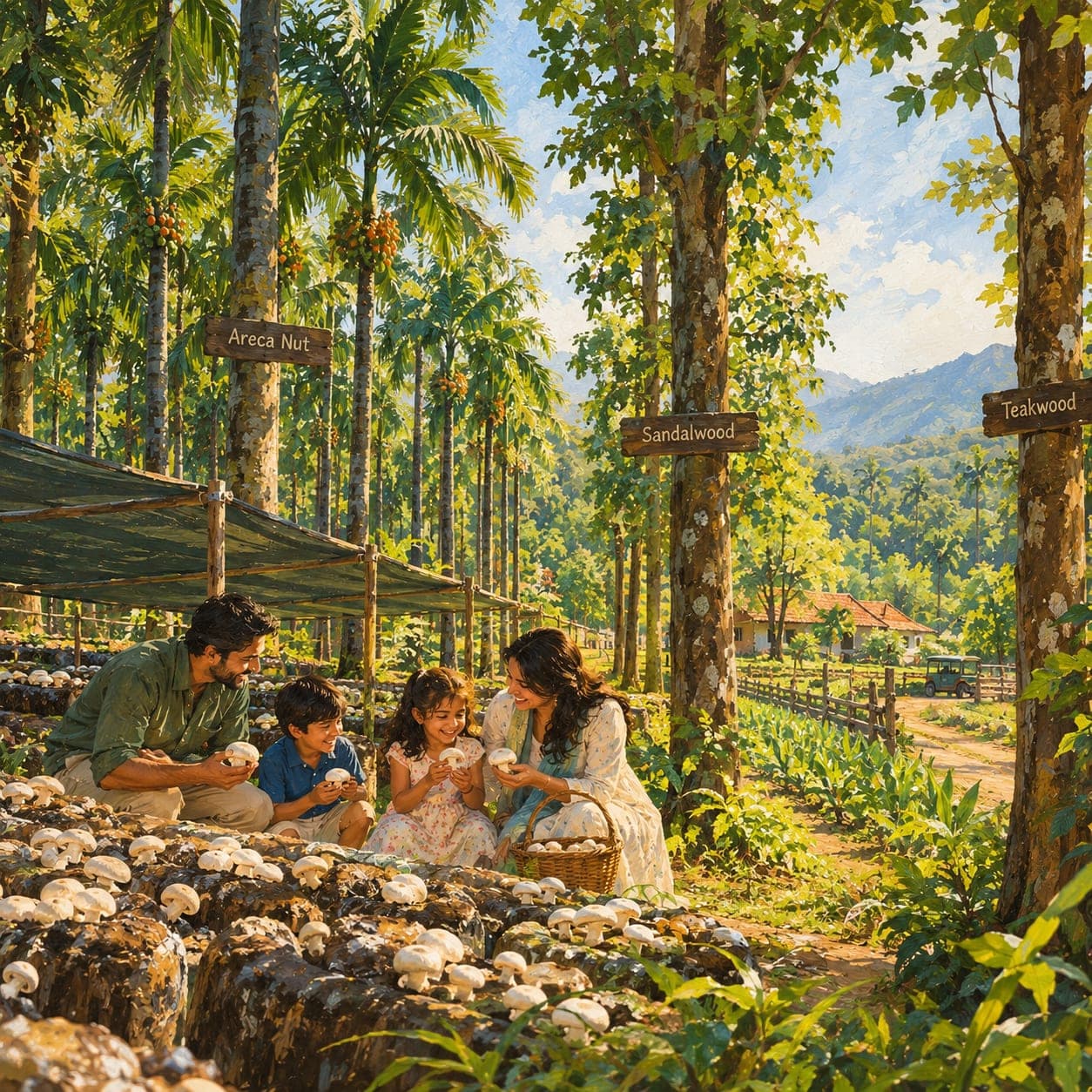
At Mother Earth Heritage by TwoFrogs, Yadiyur, agriculture goes beyond traditional plantations. The project explores modern farming practices that make smarter use of space, resources and technology—including mushroom cultivation.
Mushrooms are grown in a controlled environment where temperature, humidity, ventilation and hygiene are carefully managed to support consistent and efficient production.
What We Produce
Our mushroom cultivation initiative is part of a diversified agricultural ecosystem, with a focus on quality, hygiene and efficient farm management.
- Controlled growing environment
- Consistent quality and hygiene
- Efficient use of space
- Managed growing conditions
- Fresh harvest for consumption
- Integrated into a diversified farm model
Production Capacity : 2500 kg/day
The goal is not simply to grow mushrooms, but to demonstrate how modern agricultural practices can complement managed farmland and create more productive, resource-efficient farming systems.
I) Agriculture That Keeps Evolving
From mushroom cultivation to plantations, Mother Earth Heritage brings together a modern approach to farming through managed farmland, modern agriculture, plantations, nature and lifestyle. It offers a farmland experience for those who want to stay connected with agriculture while enjoying the convenience of professional farm management.
J) FAQs
1. What mushrooms are grown at Mother Earth Heritage?
We cultivate White Button Mushroom in a controlled growing environment.
2. How much do you produce?
Our current production is approximately 2500kgs per Day
3. Where are the mushrooms grown?
They are cultivated at Mother Earth Heritage, Yadiyur, using managed growing facilities.
4. Why grow mushrooms in a controlled environment?
It helps manage temperature, humidity, ventilation and hygiene for consistent production.
5. Is mushroom farming part of managed farmland?
Yes. It is part of the modern agricultural ecosystem developed at Mother Earth Heritage.
Explore the Future of Modern Farming
Discover how innovative agricultural models, managed farmland and value-added farming can create new possibilities for the next generation of landowners and agripreneurs.
Learn. Experience. Grow.
Website : motherearthheritage.twofrogs.in